
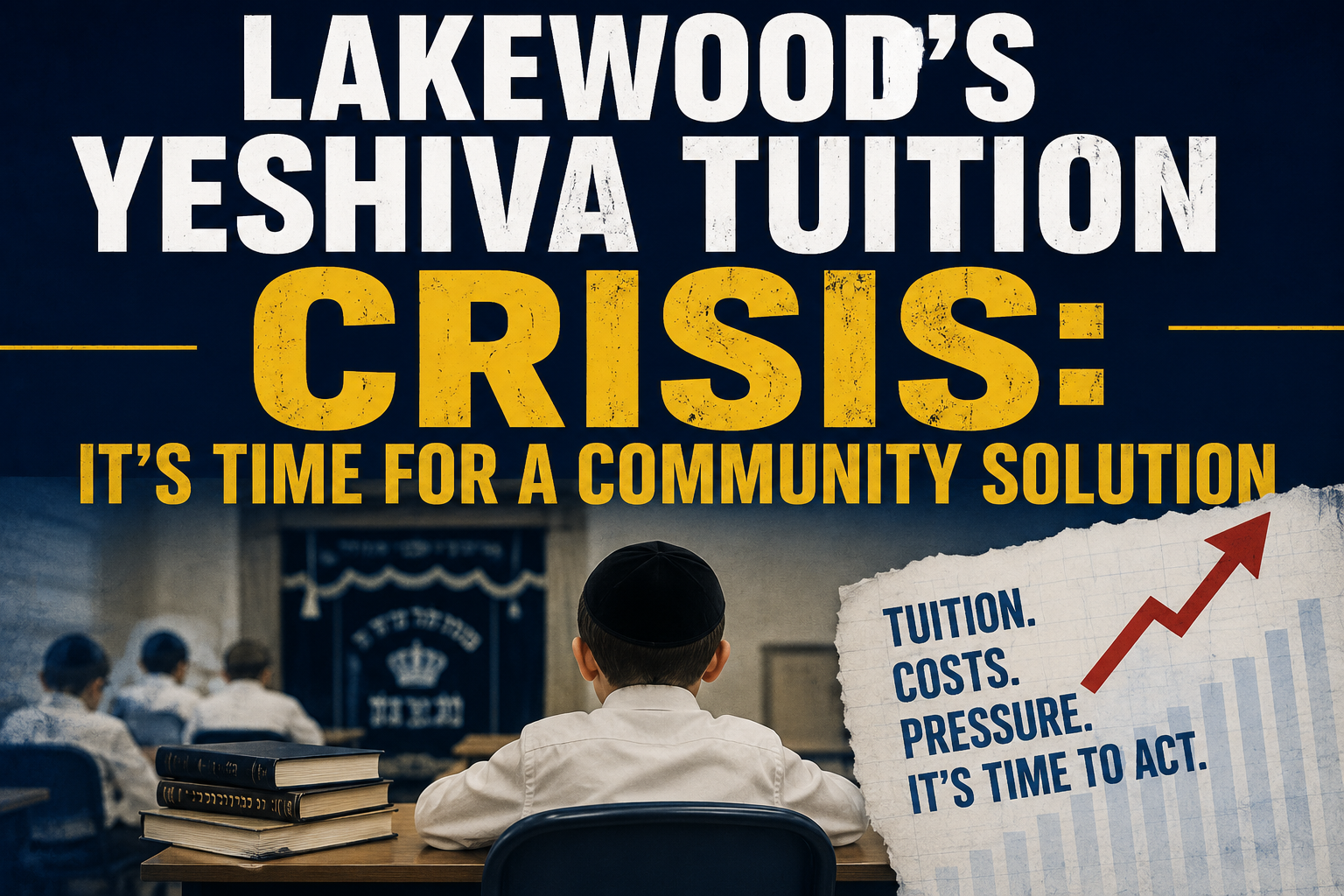
LETTER:LAKEWOOD’S YESHIVA TUITION CRISIS: IT’S TIME FOR A COMMUNITY SOLUTION

LETTER:LAKEWOOD’S YESHIVA TUITION CRISIS: IT’S TIME FOR A COMMUNITY SOLUTION

Many Lakewood mosdos are struggling to make payroll while parents are overwhelmed by rising tuition and the increasing cost of living. Rabbeim deserve to be paid on time, families deserve a tuition system they can realistically afford, and our children deserve strong, financially stable yeshivos. It’s time for our community to come together and find real, long-term solutions.

AdminJuly 14, 2026

Lakewood’s Yeshiva Tuition Crisis: It’s Time for a Community Solution

Lakewood is one of the greatest Torah communities in the world. Thousands of families moved here because of the Torah, chinuch, and special community we have built.

But today, many of our mosdos are facing a serious financial crisis that can no longer be ignored.

According to people with firsthand knowledge, many elementary schools are struggling to make payroll. Some are paying rabbeim, teachers, and staff late. Others are borrowing money just to make payroll and keep the school running.

These rabbeim and teachers are already not making large salaries. They work long hours, give everything they have to our children, and should not have to wonder when they will be paid.

Parents are also under tremendous pressure. Tuition keeps going up while the costs of housing, food, insurance, taxes, and everyday life continue to rise.

Elementary schools can charge $10,000–$12,000 per child in the upper grades. High schools are often $12,000 or more. Many batei medrash charge around $15,000. Girls’ schools can cost $6,000–$10,000, and seminaries can reach close to $30,000.

For large families, these numbers are simply overwhelming.

Continuing to raise tuition cannot happen and will not solve the problem. Many families cannot even afford the current tuition rates. Raising tuition again will only put more pressure on parents without fixing the real financial problems facing the schools.

We cannot make Torah education unaffordable for the very families who built this community.

Fundraising has also become much harder. Online campaigns worked for a while, but many people are tired of being asked again and again. Friends and relatives cannot keep supporting every school campaign every year, especially when they are struggling with their own bills.

Everyone is feeling the pressure.

Schools are trying to survive.

Parents are trying to pay tuition while also paying mortgages, groceries, insurance, taxes, and other basic expenses.

Rabbeim and teachers are giving their lives to chinuch while wondering when their next paycheck will come.

This is not about blaming the schools. Their costs have also gone up, and many administrators are doing everything they can. But we have to be honest and ask whether the current system can continue.

Possible Solutions

1. Every yeshiva should hire a professional fundraiser.

Successful organizations do not rely only on parents and online campaigns. They hire professional fundraisers who can build relationships, find major donors, apply for grants, and create long-term support.

2. Bring back major fundraising events.

Dinners, melaveh malkas, parlor meetings, and community events used to raise serious money for mosdos. These events should again become an important part of school fundraising.

3. Create larger scholarship funds.

People who have been blessed with wealth should help create serious scholarship funds so families can receive help while keeping their dignity.

4. Create a Lakewood Yeshiva Fund.

There should be one large community fund supported by families, businesses, and major philanthropists. The fund could help schools in emergencies, support scholarships, and help keep tuition from rising every year.

5. Get everyone together to find new solutions.

Parents, roshei yeshiva, administrators, askanim, business owners, and community leaders need to sit down together. This is too big for every school to solve alone.

Klal Yisroel has shown many times what we can accomplish when we come together.

We raised $150 million for Torah in Eretz Yisroel. Surely we can also come together to make sure the rabbeim teaching our own children are paid on time and that Lakewood families can afford tuition.

Our rabbeim deserve to be paid on time.

Our parents deserve a system they can realistically afford.

Our mosdos deserve financial stability.

Most importantly, our children need yeshivos to attend.

The time to start this conversation is now.

B.R.

Lakewood

Comments

No comments yet. Be the first!

Related Articles

 LETTER:  COFFEE IN SHUL: WHY ARE WE SO BUSY WATCHING EVERYONE ELSE?
NUNU letters

LETTER: COFFEE IN SHUL: WHY ARE WE SO BUSY WATCHING EVERYONE ELSE?

There has been a lot of discussion lately about bringing coffee into shul. Every shul has a Rav, and every Rav has the right to decide what is appropriate for his shul and what the decorum should be. If a Rav says no coffee, that should obviously be respected. But my broader question is: Why are we so worried about what the person next to us is drinking? If someone walks into shul holding a coffee, why should that disturb my davening? My job is to daven, focus on Hashem, and not spend my time looking around and judging what everyone else is doing. Talking during davening is different. Chazal and the poskim speak strongly about it, and practically, someone talking can directly interfere with another person’s ability to daven and concentrate. But someone quietly drinking a coffee? Even if you personally feel it isn’t appropriate or respectful, why does it have to become everyone else’s concern? And more broadly, it is worth asking why we so often feel the need to point out what others are doing wrong. Even when we are convinced we are right, what is gained by writing about it, commenting on it, or focusing on it? Too often, it shifts our attention away from our own avodah and places it onto someone else’s behavior. Instead of elevating ourselves, it can easily lead to more judgment, more division, and less focus on our own growth. We should also remember that the real work is not to refine other people, but to refine ourselves. We are far more responsible for our own middos, our own kavanah, and our own growth than we are for anyone else’s choices. If we invested the same energy we sometimes spend analyzing others into improving ourselves, we would likely see far greater progress in our own avodas Hashem. Maybe part of proper shul decorum is also learning to focus less on what the person next to us is doing and more on our own davening and on how we can become better ourselves. Let every shul’s Rav set the standards for his shul and let the rest of us concentrate on talking to Hashem and becoming better people ourselves.

Aug 16
 LETTER: THE HIDDEN GAMBLING CRISIS IN THE FRUM COMMUNITY
NUNU letters

LETTER: THE HIDDEN GAMBLING CRISIS IN THE FRUM COMMUNITY

GAMBLING IN THE FRUM COMMUNITY I wanted to speak publicly about a major issue in our community that many people know exists, yet too often gets pushed under the carpet. People are embarrassed to talk about it. Families hide it. Friends cover for each other. But as someone who has personally seen people lose their savings, their homes, their marriages, and sometimes their entire lives because of gambling, I feel this needs to finally be addressed honestly. We are supposed to be an אור לגויים, a light unto the nations. Yet gambling has quietly become normalized in many circles. What once may have started as a small poker game, a friendly sports bet, or a few scratch-offs has exploded into something much bigger and much darker. Today gambling is everywhere. It’s scratch-offs at convenience stores. It’s lotto tickets where people stand there every day scratching away money they can’t afford to lose. It’s casinos in Atlantic City and Vegas. It’s online gambling apps sitting in everyone’s pocket 24/7. It’s sports betting commercials during every game convincing people they are one big win away from changing their lives. And now with the new age of sports gambling apps, it has become easier than ever to destroy yourself financially without anyone even noticing. Years ago someone had to physically walk into a casino. Today someone can lose thousands of dollars quietly from his couch, in his car, during work, or even during a family simcha. The apps are designed for one purpose: to keep people chasing losses. The system is built so most people lose. Maybe someone wins once or twice in the beginning, but that is often what hooks them. Then comes the chasing. “I’ll make it back.” “One more game.” “One more parlay.” “One more hand.” Before they know it, savings accounts are emptied, credit cards are maxed out, and debts start piling up. And gambling addiction does not stay only in the casino or on the app. Many times it leads people into stealing, scamming, lying, fraud, and Ponzi schemes because they become desperate trying to cover losses or chase money they already lost. People who never imagined they would cross certain lines suddenly justify doing terrible things because they believe one big score will fix everything. We have already seen major scandals in frum communities where gambling and reckless financial behavior were connected behind the scenes. Families destroyed. Investors wiped out. Trust shattered. Communities embarrassed publicly. And usually by the time people realize what is happening, the damage is already massive. Many wives and families have absolutely no idea what is happening. There are frum families struggling to pay tuition, groceries, mortgages, and basic bills while secretly tens or hundreds of thousands of dollars are disappearing into gambling. Some people borrow from friends. Some refinance homes. Some destroy business relationships. Some end up lying constantly to cover up the addiction. The stress and pressure destroy shalom bayis and emotionally crush children who have no clue why their home is falling apart. The saddest part is that many of these people are not bad people. They are regular people who got trapped. Addiction does not care if someone is religious, successful, respected, wealthy, or learned. Gambling addiction grabs people quietly and slowly until they no longer control it. And the community often looks the other way. People are afraid to speak because of shidduchim, embarrassment, image, or fear of what others will say. So instead of dealing with the issue early, it grows in silence until there is a disaster. We need more awareness. We need rabbanim, schools, organizations, and community leaders to speak openly about this issue before more families are destroyed. We need people to understand that gambling addiction is real and dangerous. We need support systems for those trying to get out. We need education for young people who are growing up in a world where gambling is being marketed as entertainment everywhere they turn. Most importantly, we need to stop pretending this problem does not exist in the frum community. Because it does. And for some families, it is destroying everything.

May 27